Soneva Jani vs Soneva Fushi: Which One to Book in 2026
By AreefMV·Updated 30 Aug 2026·14 min read
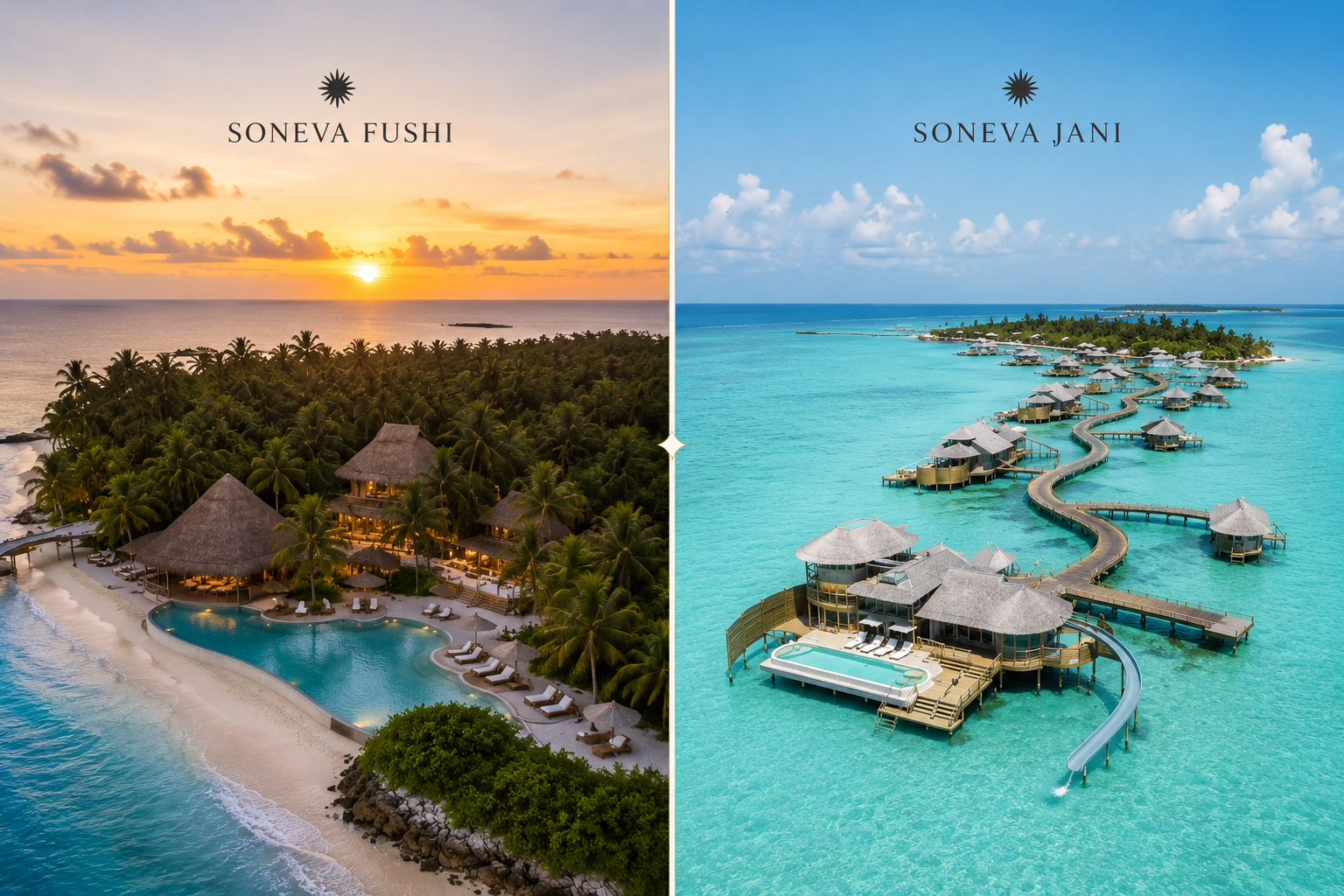
Soneva Jani and Soneva Fushi are the two flagship resorts of one of the most respected luxury hospitality brands in the world. They share a philosophy of barefoot luxury, no news, no shoes and deep sustainability, and they share many of the signature touches that make Soneva, Soneva: the Chocolate Room, the ice cream parlour, Cinema Paradiso, the Observatory, the Barefoot Guardian service.
But they are not interchangeable.
Couples who would love Fushi sometimes find Jani strangely quiet. Families who thrive at Fushi can feel cramped at Jani. Divers gravitate to one; honeymooners to the other. The difference matters, and at this price level (a single seven-night stay can easily run past US$30,000), it's worth getting right.
At IM Maldives, our team has stayed at both properties and we place clients at each every season. This guide breaks down what genuinely distinguishes them: villas, dining, the reef, the transfer, the atmosphere, and at the end, we tell you exactly which one fits which kind of traveller.
At a Glance, The Quick Verdict
The fastest way to understand the difference:
Soneva Fushi at a glance
Atoll: Baa Atoll (UNESCO Biosphere Reserve)
Opened: 1995, the original Soneva
Island: Kunfunadhoo
Villa style: Beachfront jungle villas, plus 8 newer overwater retreats
Transfer: ~30-minute seaplane on Soneva's own private fleet
Dining: 14 venues, including the zipline restaurant Flying Sauces
House reef: One of the best in the Maldives, exceptional biodiversity
Hanifaru Bay manta access: Yes, 20 minutes by boat (June–November)
Signature feature: Cinema Paradiso, the Observatory, the Glass Studio, The Den kids' club
Best for: Families, divers, multi-generational stays, experience-seekers
Soneva Jani at a glance
Atoll: Noonu Atoll
Opened: 2016 (Chapter One), 2022 (Chapter Two)
Island: Medhufaru, plus 4 surrounding islands inside the lagoon
Villa style: Mostly overwater retreats, plus larger Island Reserves
Transfer: ~40–45-minute seaplane, or domestic flight to Maafaru + 15-minute speedboat
Dining: 13 venues, anchored by the multi-level Gathering
House reef: Lagoon-focused: gentler swimming, less reef variety
Hanifaru Bay manta access: No
Signature feature: 5.6-kilometre private lagoon, retractable bedroom roofs, water slides into the lagoon
Best for: Honeymooners, couples, design-led travellers, milestone trips
One-line verdict: Fushi is for travellers who want to do everything. Jani is for travellers who want to do nothing, beautifully.
The DNA of Each Resort
Soneva Fushi, The Original
Soneva Fushi opened in 1995 and effectively invented "barefoot luxury" in the Maldives. It sits on Kunfunadhoo, a long, jungle-covered island in the Baa Atoll UNESCO Biosphere Reserve.
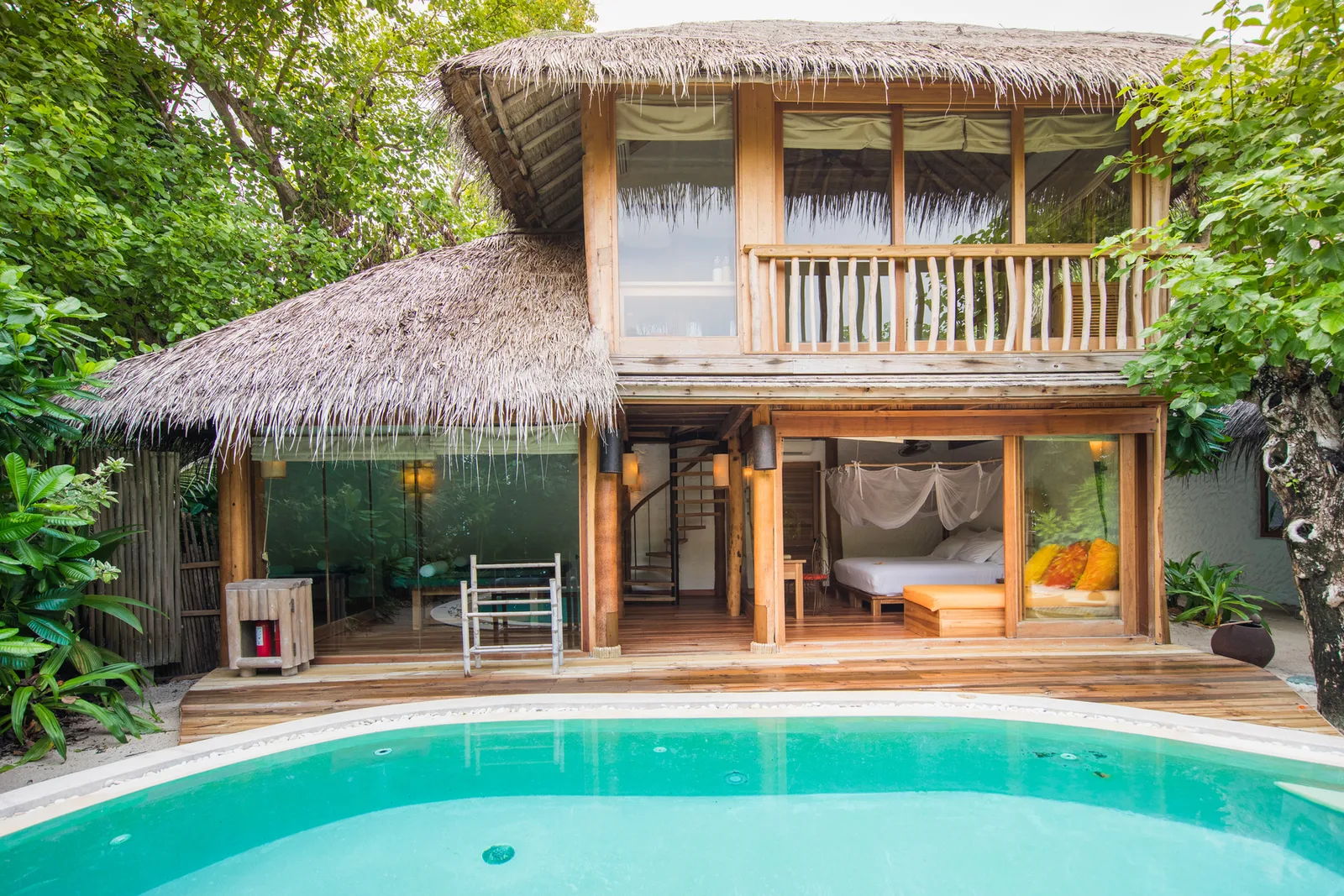
The villas are tucked into dense tropical vegetation, each with its own private stretch of beach. There are no overwater villas in the traditional sense: Fushi's signature is the jungle-meets-beach villa, often two-storey, with private pool, hammock, bicycle, and sand at the threshold. (A small group of overwater retreats was added in recent years, but they are the exception, not the rule.)
Fushi feels less like a hotel and more like a working ecosystem. There's a glass-blowing studio, the only one in the Maldives, where guests turn recycled glass into art. There's a high-spec observatory for stargazing. There's an open-air cinema, Cinema Paradiso, screening films on the beach with popcorn delivered to your sun lounger. The Den, the resort's children's club, is the largest in the country at over 1,300 square metres. There's even a zipline restaurant called Flying Sauces, where guests are harnessed in and served a tasting menu through the treetops.
It is one of the most "things to do" of any luxury resort in the Maldives.
Soneva Jani: The Newer, Quieter Sibling
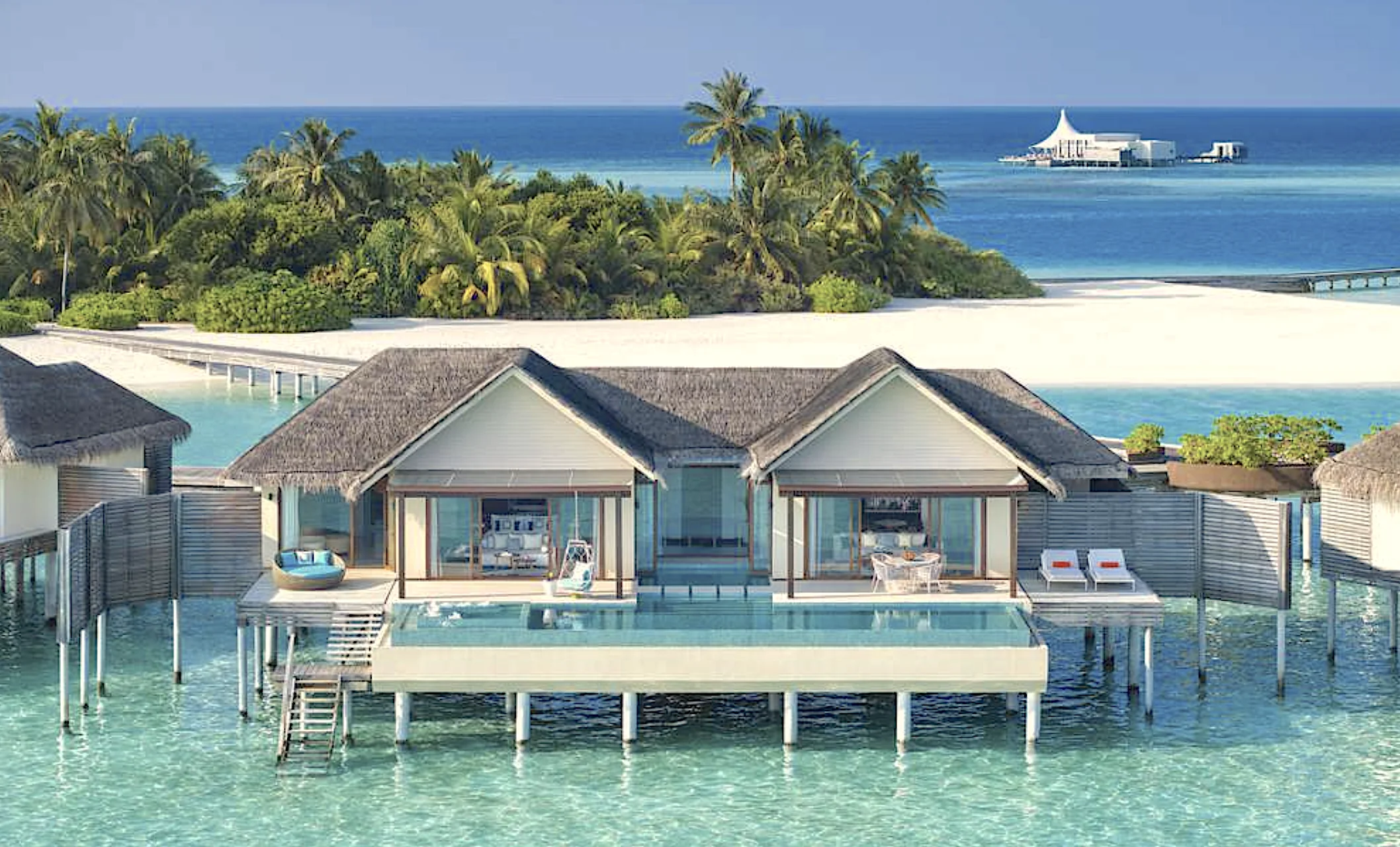
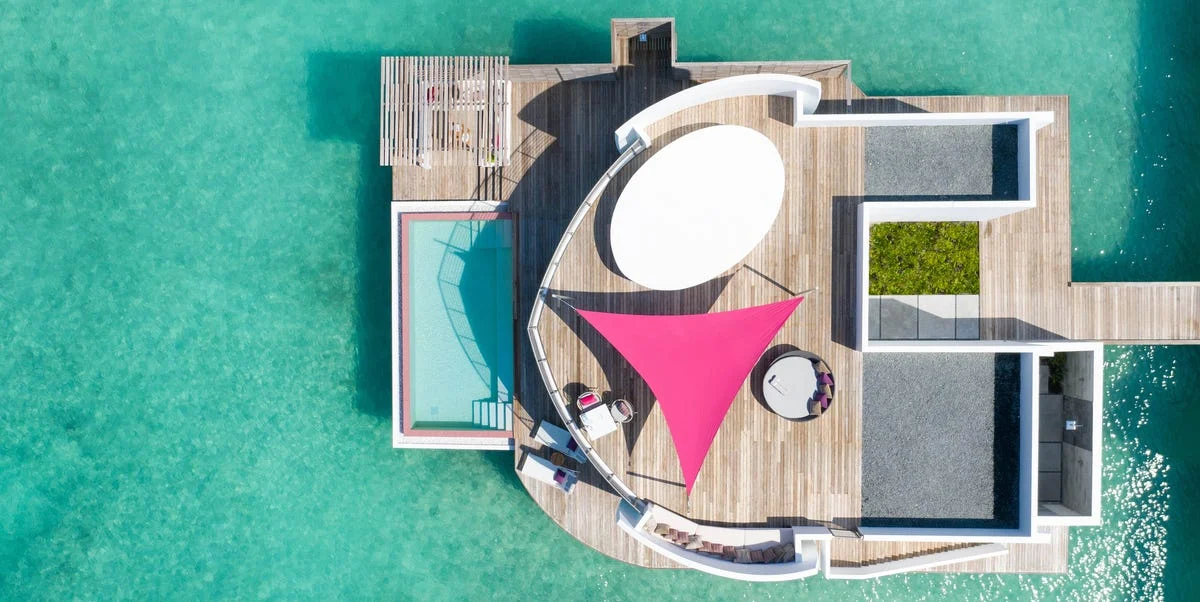
Soneva Jani is a generation younger. It opened in 2016 in Noonu Atoll, on the island of Medhufaru, surrounded by a 5.6-kilometre private lagoon, the largest of any resort in the Maldives. Where Fushi is jungle-and-beach, Jani is water-and-sky. Most villas are overwater, set along two jetties that extend into the lagoon. They are larger than Fushi's overwater equivalents (Water Retreats start at 411 square metres), with retractable bedroom roofs for stargazing from bed and, in many villas, a curling water slide from the upper deck straight into the lagoon.
"Chapter Two" of Jani, completed in 2022, added 27 new Water Reserves and several Island Reserves on the surrounding islands. The Water Reserves are some of the largest overwater accommodations in the world. The Island Reserves, with two to four bedrooms, sit on the beachfront of the smaller islands and are designed for families and groups who want overwater proximity without overwater living.
Jani is quieter than Fushi. The lagoon is glass-still in good weather, and the resort programming is gentler: fewer scheduled activities, more pause. The dining venues, including the multi-level Gathering at the heart of the resort, are tighter and more curated than Fushi's sprawling collection.
Villas ComparedFootprint and Style - Fushi villas are jungle-screened beach houses. They start at around 264 square metres for a one-bedroom and climb to a nine-bedroom Private Reserve that is one of the largest private residences in the Indian Ocean. Most are single-storey with high pitched roofs, open to a private garden, a private pool, and a private beach. Outdoor bathrooms, indoor-outdoor living, deep tropical greenery, that's the Fushi signature.
Jani villas are overwater first. The Water Retreats start at 411 square metres across two storeys, with the master bedroom upstairs under a retractable roof, the living area on the ground floor, and a deck that drops directly into the lagoon. Island Reserves sit on the beach with two to four bedrooms, designed for the largest groups.
The Water Slide - Both resorts have water slides in some villas, but Jani made them the brand signature. At Jani, the slides are part of most Water Retreat and Water Reserve categories: a curling slide from the upper deck into the lagoon below. At Fushi, slides exist only in the eight newer overwater retreats, the jungle villas don't have them.
If "I want a villa with a water slide" is on your shortlist, the answer is Jani.
Privacy and Density - Fushi villas are jungle-screened, you can spend a week and rarely see a neighbour. The vegetation is dense, the paths wind, the buggies are quiet. The privacy at Fushi is the privacy of a forest.
Jani villas on the jetty face open lagoon, which is its own kind of privacy: uninterrupted ocean views, glass-still water, no one walking past. But neighbouring villas are visible from the deck, and the jetty does mean a shared walkway. The privacy at Jani is the privacy of a horizon.
Dining
Both resorts share Soneva's dining core: the Chocolate Room, the cheese and charcuterie room, the ice cream parlour with 60+ flavours, the Wine Cellar, all complimentary across both properties when guests are on the Soneva Unlimited package.
Where they diverge is in the venues themselves.
Soneva Fushi runs around 14 dining concepts. Highlights include Out of the Blue, the Mediterranean overwater restaurant; Fresh in the Garden, the treetop restaurant accessed by a small bridge above the herb garden; Flying Sauces, the world's first zipline fine dining experience; and Mihiree Mitha, the all-day buffet. The Wine Cellar holds over 500 labels.
Soneva Jani runs around 13 dining concepts, but the experience feels tighter. The Gathering is the multi-level central hub: sushi at one level, fine dining at another, a bar above. So Hands On is the Japanese omakase experience. So Soneva is the destination dinner: different setting each night, sometimes on a sandbank, sometimes on the lagoon. The dining at Jani is more curated, less theatrical.
The Reef and the Marine Life
This is where the resorts diverge most sharply, and for many travellers it's the deciding factor.
Soneva Fushi has one of the best house reefs in the Maldives. It rings the island, with three to four access points primarily along the sunset side. The reef is exceptionally fish-rich, with regular sightings of reef sharks, sea turtles, eagle rays, and dolphins.
Baa Atoll UNESCO Biosphere status guarantees outstanding biodiversity. And critically, Hanifaru Bay, the world's largest seasonal manta ray aggregation site, is just 20 minutes by boat from the resort.
From June to November, snorkelling at Hanifaru with feeding mantas and the occasional whale shark is the kind of experience travellers fly across the world for.
Soneva Jani sits in a lagoon. The water is breathtaking, the 5.6-kilometre stretch of glass-clear lagoon is genuinely one of the most beautiful sights in the Maldives, but the reef experience is more limited than Fushi's.
Snorkelling from your villa is gentle and lovely, but for serious reef variety, you need a boat trip out to the atoll's external reefs. There is no Hanifaru-equivalent in Noonu.
If diving and reef life matter to your trip, Fushi wins this category outright.
Children, Families, and Multi-generational Stays
Fushi is the family choice, and it's not close.
The Den at Soneva Fushi is the largest kids' club in the Maldives at over 1,300 square metres: a full pirate ship, two pools, a Lego room, a music studio, programming for ages 4 to 17. Fushi's villas scale up to nine bedrooms in the Private Reserve, with private chefs and dedicated villa managers, designed specifically for multi-generational buyouts. The activity ecosystem (glass blowing, observatory, marine biology programmes for kids, cooking classes) means children of every age have a full week's worth of things to do.
Jani works for families, particularly families with older children: the slide is a hit, the retractable roof feels like magic, the Island Reserves have the space, but it lacks Fushi's sheer family infrastructure. Younger children especially will get more out of Fushi.
For honeymoons, the calculus reverses. Couples often find Fushi too programmed and prefer the deeper quiet at Jani.
Sustainability
Both resorts share Soneva's industry-leading sustainability programme: 95%+ waste recycling, the Eco Centro waste-to-wealth facility, a mandatory 2% carbon levy on all bookings that funds reforestation and clean cookstove projects, and the Soneva Foundation's broader environmental work. Soneva Fushi also runs the world's first sustainable surfing programme.
This isn't a meaningful differentiator between the two, they share a baseline that few other Maldives resorts come close to. Mention it if it matters to you, but it shouldn't tip your decision either way.
The Transfer Experience
Fushi: Approximately 30-minute seaplane flight on Soneva's own fleet of retrofitted Twin Otter aircraft, configured with eight VIP seats instead of the standard fifteen. Guests use a private Soneva lounge at the Malé seaplane terminal before departure. The seaplane transfer is included in the villa rate.
Jani: Approximately 40–45-minute seaplane from Malé, or a domestic flight to Maafaru International Airport followed by a 15-minute speedboat. Seaplanes only operate in daylight, so any international flight landing in Malé after roughly 3:30 pm forces you into either an overnight in Malé or the Maafaru route. For Jani, that workaround is a relatively quick domestic flight + speedboat. For Fushi, it's the same overnight-in-Malé question with a longer domestic alternative.
If your international flight lands late in Malé, Jani is genuinely easier to reach.
What It Costs, A Note on Pricing
We deliberately don't publish fixed rates for Soneva on this page. Both resorts move with the season, sell different villa categories at different inclusions, and run private offers: early-booking rates, honeymoon perks, longer-stay benefits, that aren't always public. A number we publish today is may get wrong by next month.
What we can tell you honestly:
Soneva is in the ultra-luxury tier. Entry-level villas at both resorts price in the high four figures per night before tax. Larger villas: the Water Reserves at Jani, the multi-bedroom Reserves at Fushi, climb sharply from there.
Total is more than the nightly rate. Maldives stays carry 10% service charge, 17% GST, a 2% carbon levy at Soneva, and a $12 per person per night Green Tax. Plan for roughly 30% on top of the published rate.
Soneva Unlimited (all-inclusive) is usually worth it. The premium covers food, beverage, excursions, and selected spa: at Soneva's price points, the maths almost always works out in favour of opting in.
Transfers are included at both resorts when booked through us.
For a quote on your specific dates, villa preference, and meal plan, including any current offers we're holding for either property, call our specialists directly:
📞 +960 771 9666
✉️ Send an enquiry: immaldives.com/enquiry
We'll come back within 24 hours with live pricing and our honest read on which villa category fits your trip.
Which Soneva Should You Book?
This is the decision-framework. Use it as a checklist.
Pick Soneva Fushi if you:
· Want the best house reef of any luxury Maldives resort
· Are travelling with children of any age, especially under 12
· Plan to swim with manta rays at Hanifaru Bay (June–November)
· Want to do things: multiple dining concepts, observatory, glass studio, cinema, marine biology
· Prefer jungle and beach to overwater villas
· Are doing a multi-generational buyout or large family reunion
· Care about being on the original Soneva property, with 30 years of polish
Pick Soneva Jani if you:
· Are honeymooning, on a milestone trip, or travelling as a couple
· Want a true overwater villa as the centrepiece of the trip
· Prefer pause over programming
· Love the idea of a retractable roof and stargazing from bed
· Want the longest, calmest lagoon in the country to swim in
· Are arriving on a late international flight (Maafaru speedboat option)
· Want the newest Soneva product, with the largest overwater villas in their portfolio
Pick both if you:
Have ten or more nights and want to combine: the Soneva in Aqua yacht runs between the two as a cruise experience in itself, and our team often arranges split-stay pricing across the two properties.
Talk to a Specialist Who's Stayed at Both
The right Soneva for you depends on details a website can't capture: your travel dates, who's coming, whether you're chasing manta season, what time your flight lands in Malé, whether you want a slide or a chocolate room.
Our team has stayed at both properties and books clients into Soneva regularly, with rates and inclusions that aren't always publicly listed.
Tell us your dates and we'll match you to the right resort, and the right villa within it, within 24 hours.
📞 Call us on +960 771 9666 or send an enquiry at immaldives.com/enquiry.
Frequently Asked Questions
Is Soneva Fushi or Soneva Jani better?
Neither is universally better, they suit different travellers. Soneva Fushi is the family, diving, and experience-driven choice. Soneva Jani is the honeymoon, overwater, and quiet-luxury choice. Both are extraordinary; the difference is what you want from the trip.
Can you visit both Soneva resorts on the same trip?
Yes. The Soneva in Aqua yacht runs between the two properties as a cruise experience in itself, and the brand often offers split-stay rates across both resorts. Our team arranges these regularly for clients with 10+ nights.
Which Soneva is better for a honeymoon?
Most honeymooners prefer Soneva Jani for its quieter atmosphere, signature overwater villas, retractable bedroom roofs, and the calm of the 5.6 km lagoon. Soneva Fushi is still excellent for honeymoons, but it has more energy and more programming, better suited to couples who want activity over stillness.
Which Soneva is better for families?
Soneva Fushi, by a wide margin. The Den is the largest kids' club in the Maldives, the villas scale up to nine bedrooms for multi-generational buyouts, and the activity ecosystem (glass blowing, observatory, marine biology) keeps children of every age engaged for a full week.
Are both Soneva resorts all-inclusive?
Both offer Soneva Unlimited, an all-inclusive package covering food, beverage, excursions, and selected spa treatments. It's optional, guests can also book on a B&B or half-board basis, but most travellers opt in once they understand what's included.
Which Soneva has the better house reef?
Soneva Fushi, clearly. Fushi's reef rings the island with multiple access points and supports exceptional biodiversity, including reef sharks, turtles, and eagle rays. Hanifaru Bay manta aggregation is 20 minutes away. Soneva Jani sits in a lagoon: beautiful for swimming, but reef variety requires a boat trip out.
How much does a stay at Soneva cost?
Both resorts sit in the ultra-luxury tier: entry-level villas typically price in the high four figures per night before tax, with Water Reserves at Jani and the larger Reserves at Fushi climbing well beyond that. Maldives tax adds roughly 30% on top of the published rate (10% service, 17% GST, 2% carbon levy, $12 per person per night Green Tax).
Rates shift with season and current offers, so for a real quote on your specific dates, reach our specialists on +960 771 9666 or send us an enquiry, we come back within 24 hours.
Written by Areef, Founder of IM Maldives, a specialist Maldives travel agency with international representation in key markets. Our team has personally evaluated over 100 Maldives resorts, including both Soneva properties.
Planning to see the mantas? Read our full Hanifaru Bay manta-season guide: when to go, the rules, costs, and where to stay.
Advertisement
Planning a trip to the Maldives? Explore our curated travel packages, browse handpicked resorts, or learn about our destination wedding and group buyout services. Have questions? Check our FAQs or send us an enquiry, our curators are on the ground and ready to help.